
Dashboard on joint procurement for local government systems, with a focus on prefectures
- Last Updated:
Notice
- September 4, 2026
- Data updated successfully
Table of Contents
- 1. What is joint procurement?
- 2. Status of joint procurement
- 3. List and details of joint procurement cases
- 4. Status of joint procurement by system type
- 5. Status of joint procurement by prefecture
- 6. Important Points
- 7. Inquiries
- 8. Frequently Asked Questions
1. What is joint procurement?
Due to the rapid decline in the population, it is assumed that the shortage of government service providers will rapidly worsen. In order to address this issue, it is essential to improve the efficiency and convenience of public service provision through the use of digital technology.
Joint procurement is a procurement method in which systems are jointly procured from a single operator based on a single set of specifications agreed upon by the participating organizations.
In particular, joint procurement centered on prefectural governments can be expected to reduce system installation and operation costs through economies of scale, reduce procedural burdens through the standardization of procedures, make it easier for small local governments to introduce the system, and allow participating organizations to complement each other's expertise and know-how.
Differences between sole sourcing and joint sourcing
| Sole procurement | Joint procurement | |
|---|---|---|
| Procurement Coordination | Each local government shall implement coordination pertaining to procurement. | Representative body (prefecture, council, etc.) coordinates procurement (e.g., RFI, supplier selection, contracts, specification development, survey of intentions) |
| Procurement cost | Costs tend to remain high due to independent procurement | The cost of introduction and operation can be reduced by the effects of splitting the bill and consolidation. |
| Administrative system for procurement | Administrative systems must be established at each local government. | System procurement is possible even for small-scale local governments that have difficulty in establishing an adequate system |
| Expertise and know-how | Local governments may lack sufficient human resources and expertise. | The know-how and expertise required for human resources and procurement are mutually complementary. |
| Linkage of information and data | Local governments have different information and data | Work can be shared among local governments, and information and data can be coordinated. |
2. Status of joint procurement led by prefectures
The number of joint procurements led by prefectures is shown, divided into three areas: general affairs, operations, and tools.
You can check the types of systems that are being jointly procured across the country, the number of implementations, and consider candidates for joint procurement.
Examples of joint procurement
As examples of joint procurements, Ministry of Internal Affairs and Communications provides information sharing platforms (Miyagi Pref.), electronic contract systems (Gifu Pref.), child-rearing support apps (Nagano Pref.), document management and electronic approval systems (Osaka Pref.), budgeting and financial management support systems (Niigata, Nagano, and Saku City in Nagano Pref.), and AI minute preparation systems (Kumamoto Pref.).
3. List and details of joint procurement cases
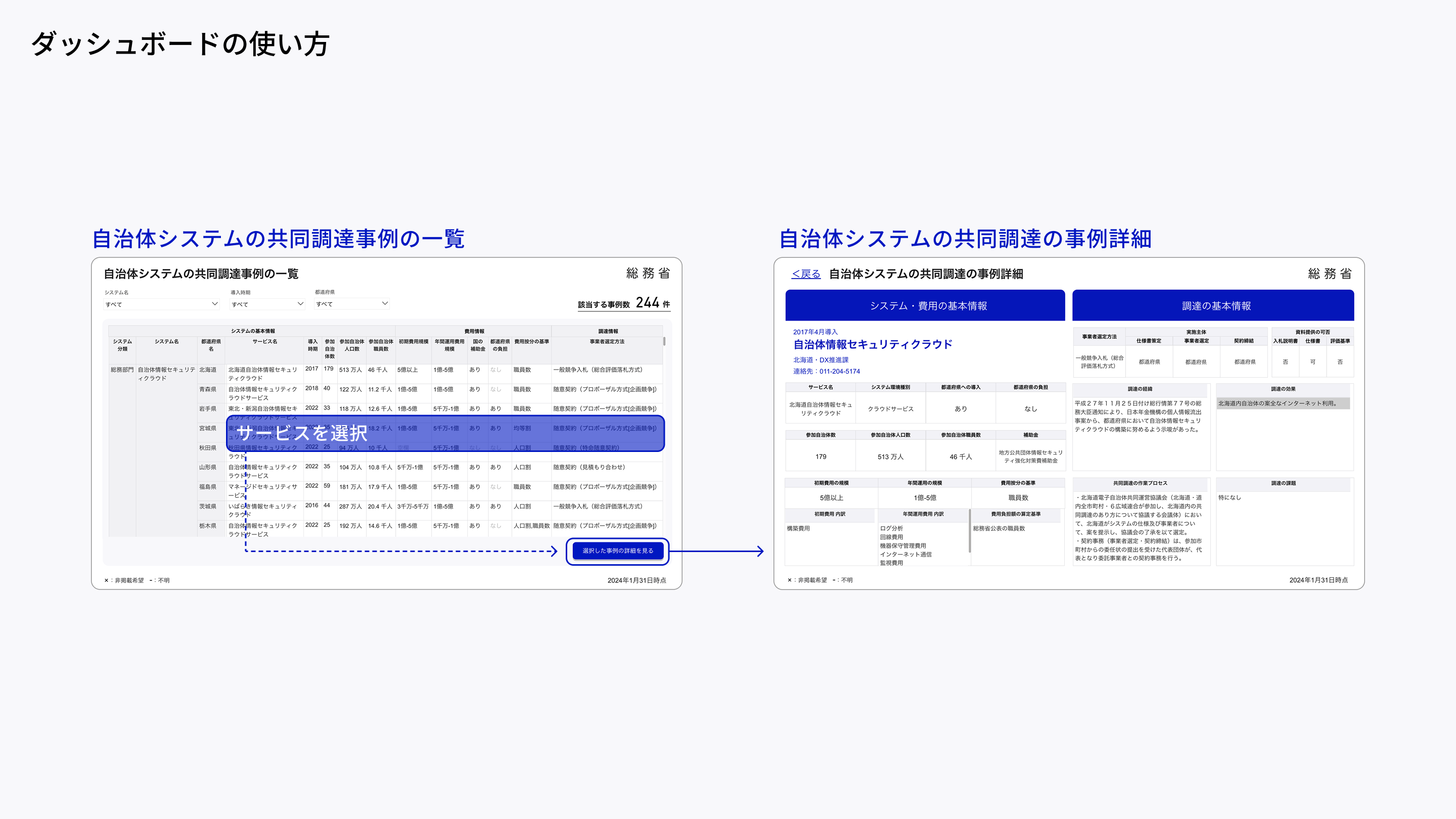
On the case study list page, you can check information such as the number of participating local governments, their population and number of employees, initial costs, and annual operating costs. You can also search for joint procurement cases that are similar in scale to your own local government.
On the case details page, you can check the cost scale of the joint procurement project, the history and process of the procurement, and whether or not the specifications can be provided. If you want to know more detailed information for the promotion of joint procurement, contact the department in charge of each case, and the know-how such as the points of joint procurement in the same system and the issues in the process can be shared among the procuring parties. If the service is registered in a DMP (digital marketplace), you can go to the service details page in your DMP to check the service content.
4. Status of joint procurement by system type
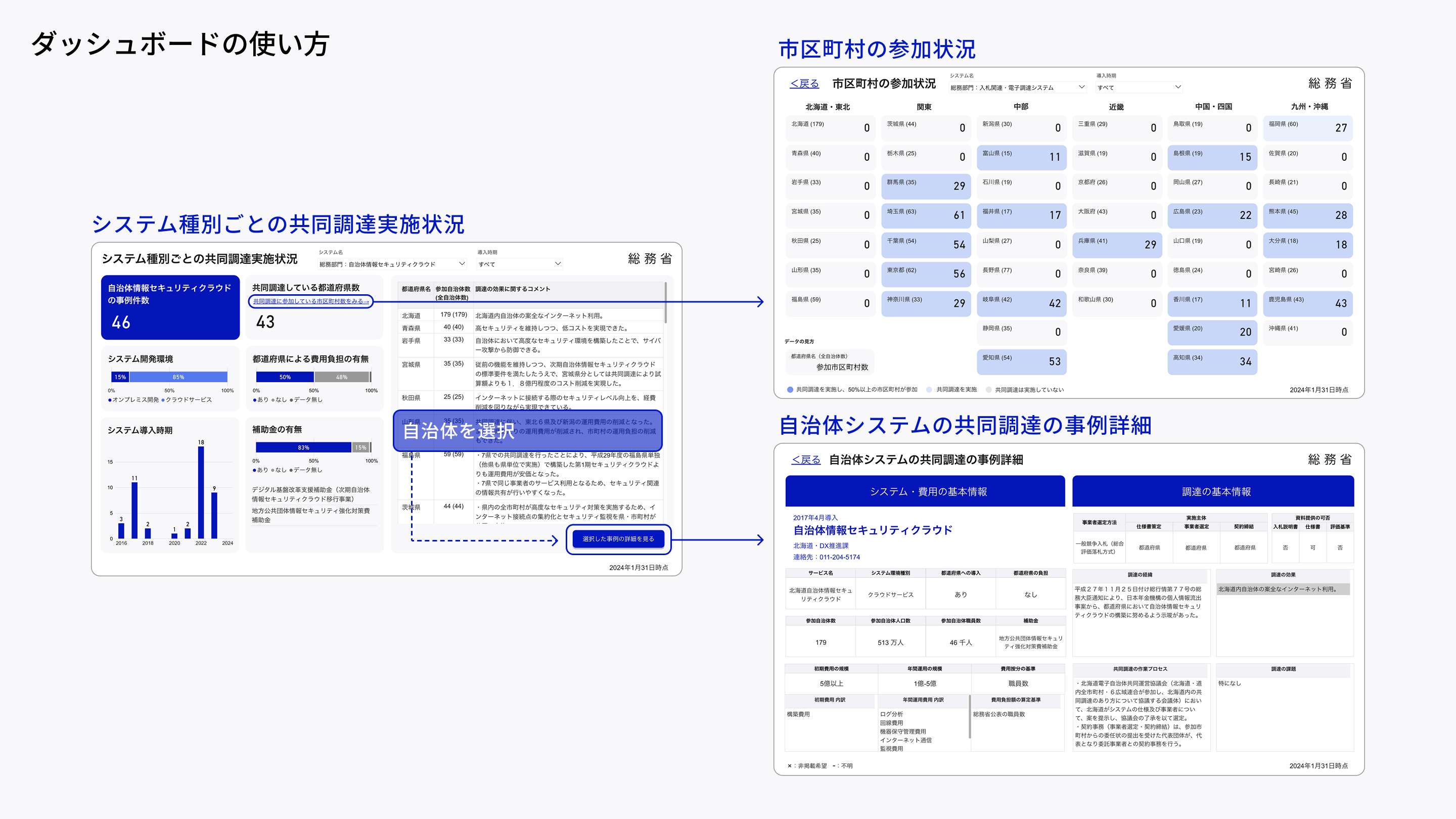
On the pages for joint procurement by system type, you can see the number of joint procurements, whether subsidies were used, the benefits realized by local government employees who implemented joint procurement, the participation of local governments in the systems being considered for procurement, and details of individual cases.
5. Status of joint procurement by prefecture
You can check the implementation status of joint procurement in each prefecture and consider the next system to be procured in your prefecture.
By checking the introduction situation of neighboring prefectures, it will also be a material to consider joint procurement across prefectures.
6. Important Points
Refresh Data
The various numbers in the dashboard will be updated regularly.
Data Definitions
For the definition of data, refer to the following.
Source of each data
The secretariat of the Cabinet Secretariat Digital Administrative and Fiscal Reform Council and Ministry of Internal Affairs and Communications asked prefectural governments to provide the various date used for the dashboard. This is a collection of joint procurement cases implemented mainly by prefectural governments (including cases implemented by councils in which prefectural governments are involved as the secretariat, observers, etc.). We have received responses on this matter from all prefectural governments. However, we do not post on the dashboard or reflect in the statistics on the dashboard cases that we do not want to publish as a whole, cases that we did not respond to, cases in which prefectural governments were not involved, and cases outside the target period.
The following data (figures for FY 2022) are used as the data for population and number of employees.
- Population, Demographic Movement and Number of Households based on the Basic Resident Register (Ministry of Internal Affairs and Communications)
- Survey on the Management of Personnel of Local Governments (Ministry of Internal Affairs and Communications
All of this data will be pulled together and published as structured data for dashboards.
- Datatable (Excel / 206 kb) (updated on September 4, 2026)
- Datatable (CSV/394KB) (updated on September 4, 2026)
True or false information
For more information on true or false information in data on this dashboard, please refer to True or False Information: Dashboard on Joint Procurements for Local Government Systems Centering on Prefectures.
7. Inquiries
Cabinet Secretariat Digital Administrative and Fiscal Reform Council Secretariat
- Phone: 03 5253 2111
Regional DX Promotion Office, Ministry of Internal Affairs and Communications Self-Government Administration Bureau
- Phone: 03 5253 5111
- Email: gyousei _ dx _ atmark _ soumu. go. jp
- *To prevent spam mail, "@" is displayed as "
_ atmark _". When you send mail, please replace "_ atmark _" with "@" (one byte).
- *To prevent spam mail, "@" is displayed as "
8. Frequently Asked Questions
If you have any questions, please refer to the Frequently Asked Questions .