
E-Prescription Adoption Dashboard
- Last Updated:
Notice
- Data was updated on October 16, 2026.
Table of Contents
- 1. What is Electronic Prescription?
- 2. Status of Utilization of Electronic Prescriptions
- 3. Introduction of Electronic Prescriptions
- 3.1. Installations by Facility
- 3.2. Status of introduction by prefecture in
- 3. 3. Introduction status of municipalities in
- 3.4. Details of introduction by municipality in Detailed introduction status by municipality
- 3.5. Case Studies
- 4. E-Prescription utilization status
- 5. Changes due to the introduction and spread of electronic prescriptions
- 6. Policies
- 7. Considerations
1. What is an electronic prescription?
E-Prescription (Ministry of Health, Labor and Welfare) is one of the initiatives of Healthcare DX (Ministry of Health, Labor and Welfare) promoted by Ministry of Health, Labor and Welfare. It is an important measure to realize the national medical information platform.
Electronic prescriptions are a mechanism by which information on drugs prescribed by physicians or dentists is transmitted to pharmacists through an electronic prescription management service, and pharmacists can also register and manage information on drugs that have been dispensed.
By promoting the introduction of electronic prescriptions, people will be able to safely share drug information at medical institutions and pharmacies nationwide and check their own drug records anywhere, leading to the enjoyment of safe and secure medical care.
2. Progress in Utilization of Electronic Prescriptions
In order to promote the use of electronic prescriptions and link them to safe and secure medical care, it is important that the introduction of electronic prescriptions be expanded at medical institutions and pharmacies, that they be utilized and become established, and that the effects of efforts be realized.
For medical institutions and pharmacies that have introduced online eligibility confirmation and other systems nationwide, the dashboard organizes the progress toward the use of electronic prescriptions into the following three stages for visualization.
- 1. Expanded introduction of electronic prescriptions
- 2. Utilization and establishment of electronic prescriptions
- 3. Execution of checks for duplicate medications, etc.
Reference: Electronic Prescription Management Service (Ministry of Health, Labor and Welfare)
Full-screen display of the "Progress toward Utilization of Electronic Prescriptions" dashboard
- * "Paper prescriptions with replacement numbers" are paper prescriptions issued by medical institutions that have introduced the electronic prescription system. A 6-digit replacement number is listed on each prescription.
- "* The most recent values for the" "rate of registration of dispensing results" "and the" "number of prescriptions dispensed at pharmacies" "(dotted line portion of the trend graph) are estimates."
- "*" "Number of duplicate medication checks performed," "" "Number of duplicate medication alerts" "and" "Number of concomitant medication contraindication alerts" "are the cumulative total of the number of cases determined through the electronic prescription management service at medical institutions and pharmacies."
For a detailed explanation of each item, please refer to the Data Definitions.
3. Introduction of electronic prescriptions
3.1 Installation Status by Facility
You can compare and confirm the introduction status of four categories of medical institutions and pharmacies nationwide that have introduced online qualification confirmation systems, including hospitals, medical clinics, dental clinics, and pharmacies that support electronic prescriptions.
View the "Adoption by Electronic Prescription Facility" dashboard in full screen
3.2 Introduction by Prefecture
You can check the introduction status of four categories of hospitals, medical clinics, dental clinics, and pharmacies that support electronic prescriptions for each prefecture on a map.
You can also check the adoption rate of electronic prescriptions in your area and the adoption status by medical institution.
See the full screen of the "Introduction of Electronic Prescriptions by Prefecture" dashboard
3.3 Introduction status of municipalities in prefectures
For each municipality in a prefecture, you can check the introduction status of four categories of hospitals, medical clinics, dental clinics, and pharmacies that support electronic prescriptions.
You can also select a city and check the installation status and installation facilities of the selected city.
3.4 Details of introduction status by municipality
By selecting a municipality, you can check the introduction status of four categories of hospitals, medical clinics, dental clinics, and pharmacies that support electronic prescriptions, as well as the facilities that have introduced them.
View the' E-Prescription Adoption Breakdown by City' dashboard in full screen
3.5 Case Studies
In Ministry of Health, Labor and Welfare, we are publishing examples of the introduction of e-prescriptions so that they can be used as a reference when considering business operations after the introduction of e-prescriptions, as well as when considering improvements to business operations after the introduction of e-prescriptions.
It is useful for considering the introduction of electronic prescriptions while confirming specific business operations and cases that have led to improved safety at medical institutions and pharmacies that have introduced electronic prescriptions.
- Electronic Prescribing Case Study (Ministry of Health, Labor and Welfare)
- Example of the Use of Electronic Prescriptions, etc. (Ministry of Health, Labor and Welfare)
4. Status of electronic prescription utilization
4.1 Registration rate of dispensing results
For each prefecture, you can check the registration rate of dispensing results (percentage of pharmacies that have registered the results of prescriptions dispensed on the electronic prescription management service) on a map for pharmacies that support electronic prescriptions.
Full-screen view of the "Electronic Prescription Dispensing Result Registration Rate" dashboard
- "* The dotted line portion of the" "Monthly Trend" "graph is an estimated value. Estimates may exceed 100% depending on the prefecture, but the upper limit is shown as 100% on the dashboard."
For a detailed explanation of each item, please refer to the Data Definitions.
5. What will change with the introduction and spread of electronic prescriptions
An increase in the number of medical institutions and pharmacies using electronic prescriptions will enable people to receive safer and more secure medical care anytime, anywhere, and will also lead to a reduction in the burden of medical treatment on medical institutions and pharmacies. 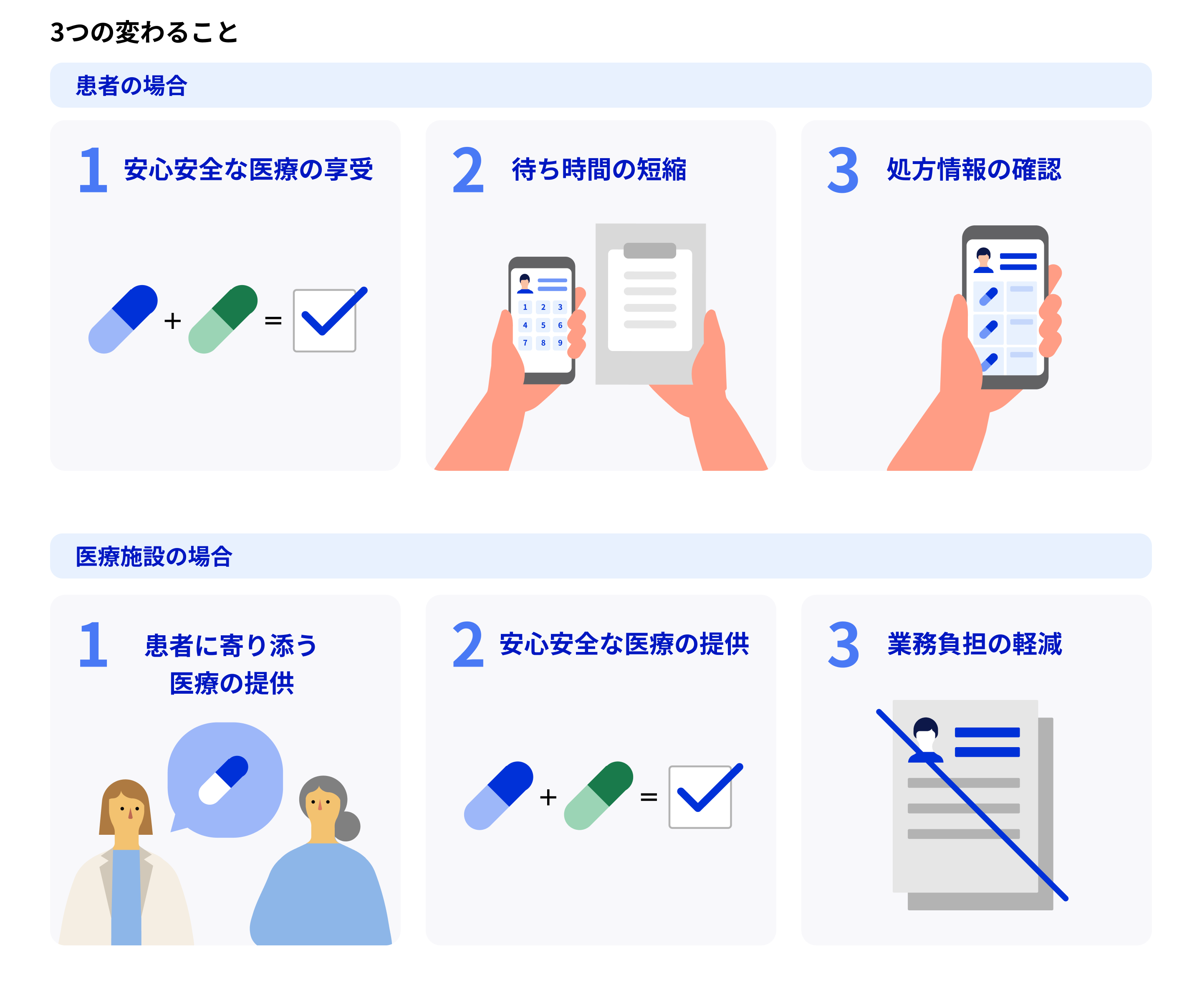
Reference: Electronic Prescription (for the public) (Ministry of Health, Labor and Welfare)
Case of a patient
- 1. Enjoyment of safe and secure medical care
- At first time medical institutions and pharmacies, patients' prescriptions and dispensing information can be checked accurately. As a result, it is possible to prevent duplicated prescriptions and dispensing of drugs with the same efficacy and effects, as well as prescriptions and dispensing of drugs that are incompatible with those being taken. This enables patients to receive safer and more secure medical care, and also leads to the optimization of medical expenses.
- 2. Reducing waiting time
- Before visiting a pharmacy, patients can provide the pharmacy with an electronic prescription replacement number, which reduces waiting times at the pharmacy.
- 3. Confirmation of prescription history
- You can check the medications you are taking at a Mynaportal, etc.
At medical institutions and pharmacies
- 1. Provision of medical care to take care of patients
- Based on the latest patient information, it is possible to provide examinations, prescriptions, dispensing, and medication guidance that are more close to patients.
- 2. Provision of safe and secure medical care
- Medical safety can be improved by sharing prescription and dispensing information across medical institutions and pharmacies, and by checking for duplicate medications and drugs contraindicated for combined use.
- 3. Reduction of workload
- It will reduce the workload of medical professionals, such as inputting dispensing information and storing paper prescriptions.
6. Related Policies
A dashboard on Healthcare DX's efforts and relevant policies is available for viewing.
- Healthcare DX Dashboard
- EHR Adoption Dashboard
- Digitalization (PMH) of projects in the field of health, medicine and nursing care implemented by local governments - Dashboard on medical care subsidies
7. Important Points
Data.
- Notice Regarding Medical Institutions and Pharmacies Handling Electronic Prescriptions (Ministry of Health, Labor and Welfare)
- The various information used for the dashboard has been collected in Ministry of Health, Labor and Welfare from medical institutions and pharmacies that have entered the date (start date of operation) on which electronic prescriptions can be issued or prescriptions can be dispensed based on electronic prescriptions on the comprehensive portal site for medical institutions, etc.
- The map on the dashboard is based on Digital Land Information (Administrative Boundaries) (Ministry of Land, Infrastructure, Transport and Tourism) .
- Due to the convenience of the system, the map mechanically displays islands of a certain area or larger.
- Datatable (ZIP/318KB) (updated on October 16, 2026)
Data Definitions
Refresh Data
The various numbers in the dashboard will be updated regularly.
True or false information
For more information on true and false data on this dashboard, please see True and False: E-Prescription Adoption Dashboard .
Comments and requests
Electronic Prescribing Service Promotion Office, General Affairs Division, Ministry of Health, Labor and Welfare Pharmaceutical and Food Safety Bureau
- Main line: 03 5253 1111
Frequently Asked Questions
If you have any questions, please refer to the e-prescription Q & A for citizens (Ministry of Health, Labor and Welfare) .