
Japanese Public Key Infrastructure (JPKI)
- Last Updated:
This section provides the basic information necessary for local governments and residents of private sector to introduce Japanese Public Key Infrastructure (JPKI * 1) (service features and certification system), service introduction examples, and useful information for introducing services (introduction methods, introduction procedures, Japanese Public Key Infrastructure usage fees, etc.).
* 1 Japanese Public Key Infrastructure
What's New
- September 18, 2026
- June 23, 2026
- April 13, 2026
- Private sector Guidelines for Japanese Public Key Infrastructure Use (Version 1.8) is now available.
- The document "Obtaining Approval for the Service to Provide Updated User Information (6. Japanese Public Key Infrastructure function Expansion in basic four information" was updated.
Table of Contents
- About Japanese Public Key Infrastructure
- Service Features
- How to deploy the service
- Service Case Studies
- How Authentication Works
- Function expansion in Japanese Public Key Infrastructure
- Inquiry
- Related Articles
1. About Japanese Public Key Infrastructure
Japanese Public Key Infrastructure is a service to provide safe and reliable identity verification for the public to authenticate users and confirm that documents such as contracts have not been tampered with, using electronic certificate on My Number Card IC chips (not My Number). Japanese Public Key Infrastructure can be introduced and used not only by administrative agencies but also for various private sector services.
The use of Japanese Public Key Infrastructure is expected to have effects such as improving customer service and reducing administrative costs. For example, it can reduce the cost and time required for customers to fill out and mail identity verification documents and application forms. It can also reduce the workload required for private sector to receive and examine documents.
Japanese Public Key Infrastructure is used by 1,431 private sector companies (as of September 30, 2026) for a variety of purposes, including opening bank and securities accounts and concluding loan contracts.
This system is operated by the Japan Agency for Local Authority Information Systems (hereinafter referred to as "J-LIS"), a corporation jointly managed by the national and local governments, based on the Public Personal Authentication Act * 2, and provides the highest level of security and reliability.
There are two ways for private sector to introduce Japanese Public Key Infrastructure. One is to obtain approval from the competent minister based on the Public Personal Authentication Act and become an approved business operator. The other is to entrust signature verification work to an approved business operator. To become an approved business operator, facilities and systems for information management in signature verification work are required. The facilities can be used in the cloud. On the other hand, by entrusting signature verification work to an approved business operator, it is possible to introduce Japanese Public Key Infrastructure without each business operator developing signature verification equipment.
Initiatives to promote the use of My Number Card and expand its use, including Japanese Public Key Infrastructure * 3, are being strongly promoted government-wide, and My Number Card is becoming increasingly convenient and easy to use for the people of Japan. Currently, the number of valid applications * 4 for My Number Card has exceeded the number of driver's licenses issued as of January 2023, reaching two-thirds of the population (approximately 83 million applications).
* 2 Act on Certification Business by Japan Agency for Local Authority Information Systems Government pertaining to Electronic Signatures, etc.
- * 3 Please refer to the following for the roadmap of major initiatives.
- Priority Plan Roadmap for the Realization of a Digital Society (PDF / 2,015 kb)
Sections on My Number Card
P7: (4) Promoting the Use and Diffusion of My Number Card
From P24 to P25: Roadmap for digitalization of Various Cards Using My Number Card
* 4 The number of My Number Card issuance applications, excluding those with incomplete documents and those whose applications were withdrawn. For the latest number of valid applications, please refer to the Dashboard on the Spread of My Number Card, Japanese Public Key Infrastructure.
2. Service Features
You can improve customer service by eliminating the need to enter information such as name and address on application forms and by reducing the time and effort required for mailing applications. You can also reduce administrative costs by eliminating the need to enter information on application forms and by reducing clerical errors. You can also strengthen security.
2.1. Improve Customer Service
Eliminate customer-borne costs such as preparation, completion, and mailing of identity verification and application forms.
For example, when making a identity verification to open a bank account, it is necessary to submit identity verification documents and an application form. By using Japanese Public Key Infrastructure, it is possible to make a identity verification and an application online. This reduces the costs required for preparation, filling out, and mailing of documents. In addition, by transferring information from the four pieces of information (address, name, date of birth, and gender) recorded in the electronic certificate for signatures, it is possible to reduce the burden and errors related to customer input. In addition, since identity verification can be completed online, it will be possible to provide services without time or location restrictions.
2. 2. Reduction of administrative costs
It can reduce the administrative costs borne by identity verification, including the receipt and examination of private sector documents and applications, as well as the mailing of notices to customers.
For example, when making a identity verification at the time of opening a bank account, it used to be necessary to receive and examine identity verification documents and application forms, as well as to request the re-sending of documents in the event of incomplete entries. By using Japanese Public Key Infrastructure, it has become possible to make identity verification and applications online, thereby reducing the workload of these tasks.
2.3. Security Enhancements
In Japanese Public Key Infrastructure, we ensure the security of communications by using a cryptographic technology called "public key cryptography".
Public-key cryptography is a method that uses two different keys (a private key and a public key) for encryption and decryption. One of the characteristics of public-key cryptography is that a message encrypted with one key can only be decrypted with the other key.
In addition, the private key is recorded on the IC chips in the My Number Card.
In My Number Card, If the information recorded on the IC chip is illegally read out, countermeasures will be taken, such as automatically erasing the information, so there is no need to worry about the private key being stolen.
For details of the public key encryption method, please refer to the following.
3. How to introduce the service
In this chapter, we will show you how to install the service for private sector who are interested in installing Japanese Public Key Infrastructure.
3.1. Service introduction method
When using a Japanese Public Key Infrastructure, the service introduction business operator must confirm the validity of the electronic certificate provided by the customer. There are two service introduction methods: becoming a "platform business operator" that implements the validity confirmation by itself, and becoming a "service provider business operator" that entrusts the validity confirmation to the platform business operator.
3.1. 1. Method of becoming a service provider operator
When a Japanese Public Key Infrastructure is used, a business operator that provides services by entrusting platform operator with the confirmation of electronic certificate validity without establishing signature verification equipment on its own is called a service provider business operator (hereinafter referred to as an "SP business operator").
Since electronic certificate validity confirmation is outsourced, it is possible to reduce the cost burden related to facility maintenance and operation, etc., and to shorten the period before service introduction, enabling inexpensive and rapid introduction. The flow of electronic certificate validity confirmation in the case of an SP business operator is as shown in Figure 1. In general, to use services related to signature verification, a service usage fee stipulated by platform operator will be charged. Usage fees vary by platform operator.
For procedures to become an SP business operator and service usage fees, please contact " 7.2.5. Inquiries regarding services provided by platform business operators ".
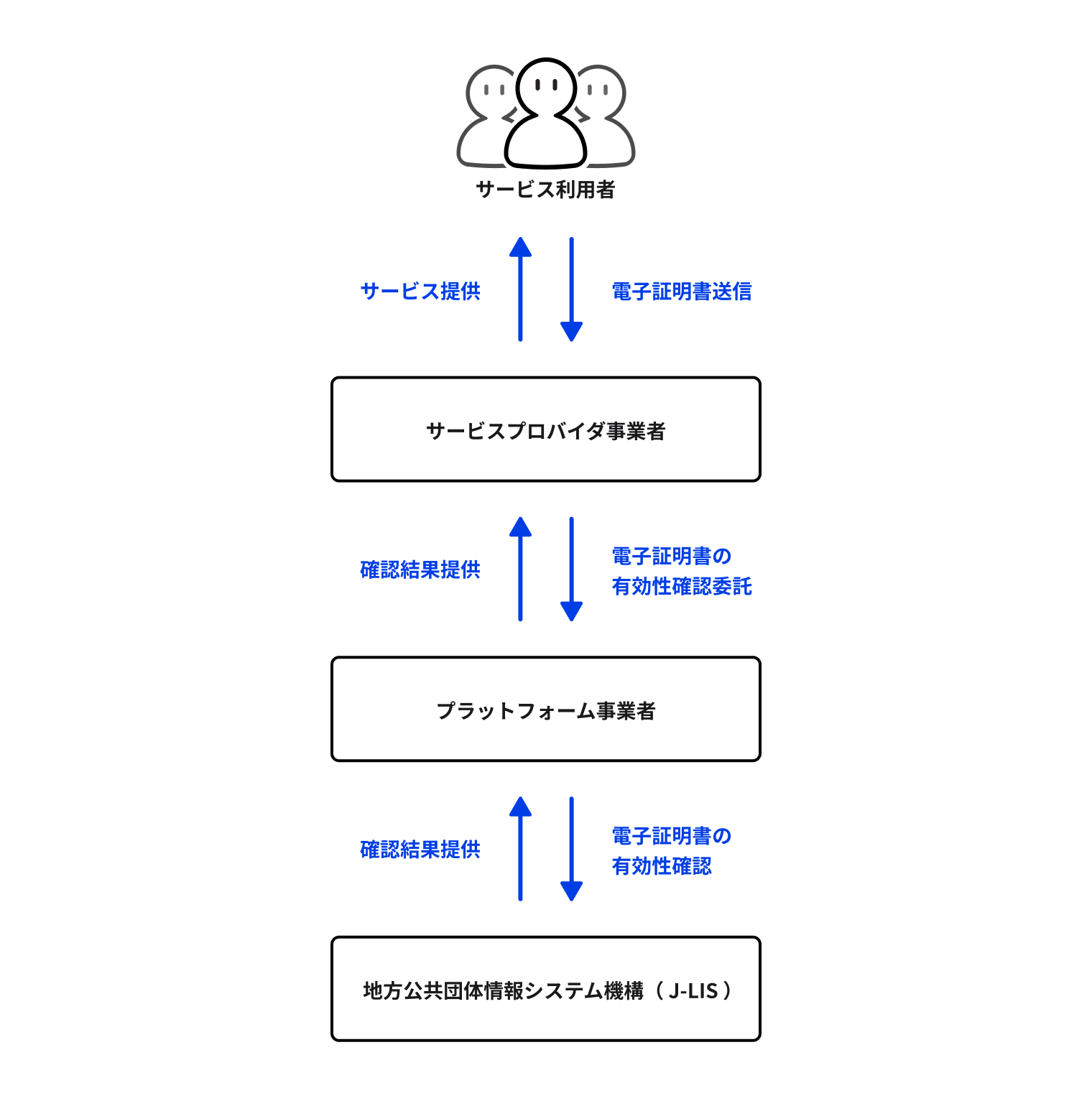
Figure 1: Flow of electronic certificate Validation Process (SP Operators)
3.1.2. Method of becoming a platform operator
When using a Japanese Public Key Infrastructure, a electronic certificate that confirms the validity of its own private sector with the J-LIS must become a "Platform Operator (hereinafter referred to as" platform operator ")" by establishing signature verification facilities and by being certified by the competent minister based on the Public Personal Authentication Act.
It is possible for platform operator to provide electronic certificate validation function to other private sector as a platform.
The signature verification equipment to be installed can also be installed in the cloud, which is expected to reduce the cost of installing and operating the equipment and shorten the time to install the service.
When using the service, a electronic certificate verification fee for the J-LIS will be charged. Fees are charged according to the number of confirmations, which is 20 yen per electronic certificate for signatures and 2 yen per electronic certificate for user certificates. From January 2023, these fees will be waived for the time being.
Please refer to "Procedures to Become a platform operator 3.2 Platform Operator in " for procedures to become a ".
3.2. Procedure for becoming a platform operator
To introduce a service as a platform operator, it is necessary to first obtain technical specifications from J-LIS and then proceed with the competent ministry's certification procedure. After certification, it is necessary to develop a system environment for signature verification and other purposes.
Please note that it takes approximately six months to one year from the acquisition of technical specifications, etc., to the acquisition of certification from the competent minister. For an overview of the procedure, please refer to the guidelines published by Ministry of Internal Affairs and Communications and Digital Agency below.
For an overview of the procedures, see "c. Accreditation Procedures" on pages 39-41.
3.2.1. Acquisition of Technical Specifications, etc.
After signing a confidentiality agreement with the J-LIS, we will apply for the disclosure of technical specifications related to the Japanese Public Key Infrastructure. Although the documents are necessary for the competent minister's certification procedure and system environment development, they are also necessary documents for considering the introduction of services, so please use them from the consideration stage.
3.2. 2. Procedures for authorization by the competent minister
Based on the technical specifications provided by J-LIS, we respond to the requirements shown in the accreditation standards, prepare documents proving that we meet the requirements, and then apply for accreditation to Digital Agency and Ministry of Internal Affairs and Communications with these documents.
For inquiries about the application, please refer to " 7.2.3. About competent ministerial certification in Japanese Public Key Infrastructure, ".
3. 2.3. Ready for production use
After obtaining certification, we will check the operation in the test environment in Japanese Public Key Infrastructure. If there is no problem, we will submit a notification to receive the results of the electronic certificate validity test from J-LIS based on the provisions of the Public Personal Authentication Act. Finally, we will check the operation in the production environment and start using the service.
3. 3. Japanese Public Key Infrastructure Fees
The use of Japanese Public Key Infrastructure is different from general national approval projects in that there are no costs associated with acquiring or maintaining certification from the competent minister, and only the electronic certificate verification fee for J-LIS is required.
The Japanese Public Key Infrastructure usage fee is based on the number of validity confirmations. The fee is 20 yen per transaction for a signature electronic certificate, and 2 yen per transaction for a user identification electronic certificate.
In addition, these usage fees will be free for the time being from January 2023 * 8. The aim is to lower the cost of using services in platform operator and to support the introduction of services. For details, please refer to the following.
* 8 The CRL method will be free of charge forever, and the OCSP responder method will be free of charge for the next three years.
4. Service Case Studies
This chapter introduces examples of Japanese Public Key Infrastructure in private sector, where it is currently introduced. It provides useful information such as how it has been introduced in what industries and services, and what benefits it has for the private sector and customers. We hope that you will find it useful in considering the introduction of e-commerce.
For example, in the banking and brokerage industries, Japanese Public Key Infrastructure is often used to open accounts, and the effectiveness of its introduction has been recognized. It eliminates the need to copy identity verification documents, fill out and mail application forms, etc., which are required at the time of opening an account. By using My Number Card's electronic certificate, customers can apply easily and accurately from smartphones and other devices. This will lead to a reduction in administrative costs such as reception and examination, as well as an improvement in customer convenience.
5. Authentication mechanism
For the Japanese Public Key Infrastructure, a electronic certificate equipped with My Number Card's IC chips is used. J-LIS, which is the issuer of electronic certificate, serves as the trust anchor (base of trust) and certifies its validity.
5.1. Effectiveness of electronic certificate
The electronic certificate must confirm the validity of the private sector submitted by the customer, since the electronic certificate loses its validity depending on the conditions.
5.1. 1. electronic certificate Expiration Conditions
Conditions for invalidating a electronic certificate include: expiration of the period of validity of the electronic certificate; change of the basic four information (address, name, date of birth, and gender) on the certificate of residence; and the person's death. There are two types of electronic certificate: a "electronic certificate for signing" and a "electronic certificate for user certification," and the invalidating conditions differ for each.
For details on the "electronic certificate for signing" and "electronic certificate for user identification", please refer to " 5.2 Types of electronic certificate ".
Please refer to the following for details on the electronic certificate revocation conditions.
5.1.2. Methods of electronic certificate validation
There are two methods for validating a electronic certificate: the CRL provision method and the OCSP responder method.
(1) CRL Provision Method
CRL * 5 is a list of electronic certificate revocation information.
In the CRL provision method, a list of electronic certificate revocation information is periodically provided (once a day, etc.).
CRLs provided by the J-LIS are updated on a daily basis. private sector downloads the CRLs to its local system and verifies the validity of the electronic certificate by matching it with the issuance number of the service user's electronic certificate.
A feature of the CRL provision method is that it can be checked offline.
* 5 Certification Revocation List
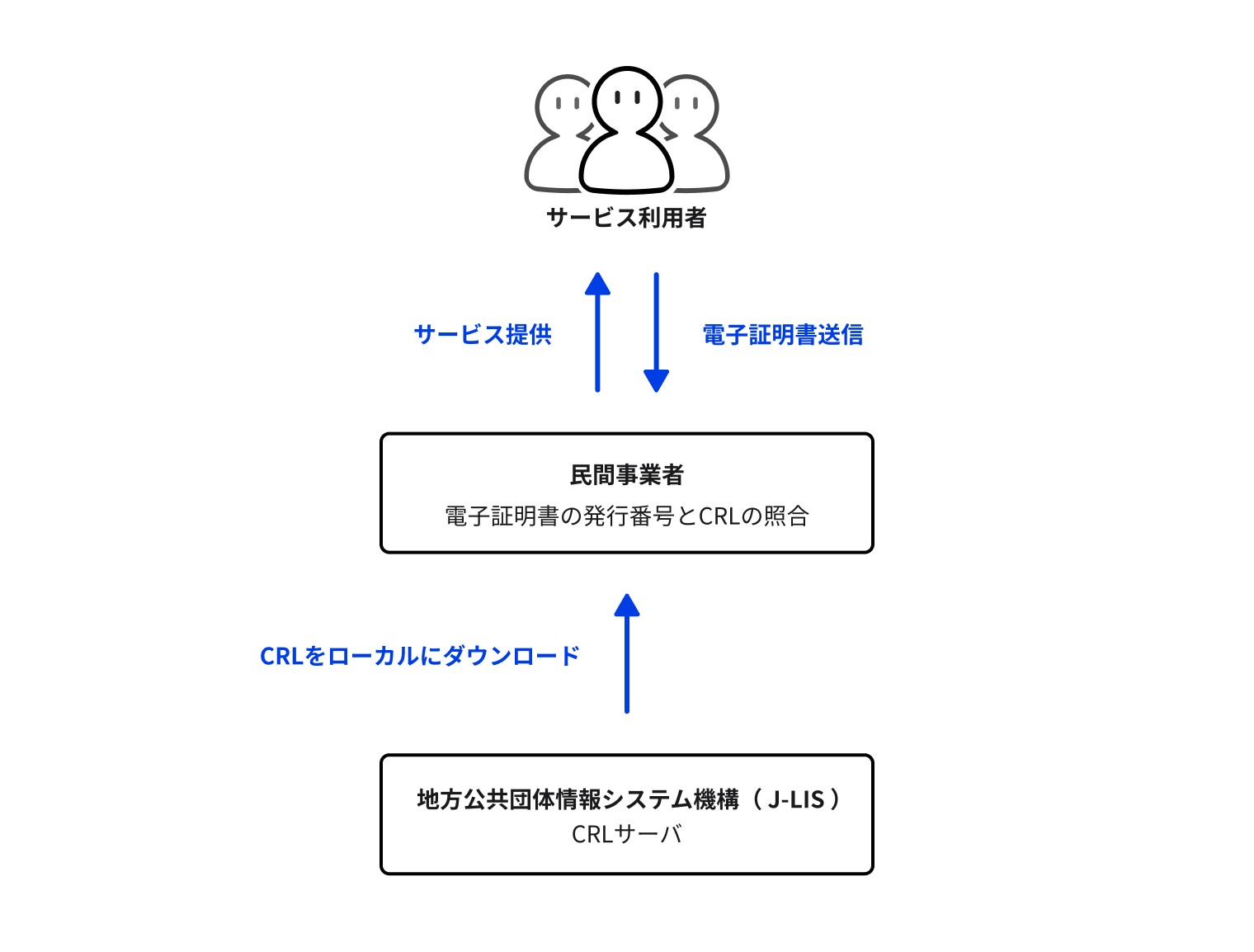
Figure 2 CRL Provision Method
(2) OCSP Responder Method
OCSP * 6 is a communications protocol for confirming the validity of a electronic certificate.
In the OCSP responder method, a server called an "OCSP responder" responds individually to inquiries about the validity of a specific electronic certificate.
The OCSP responder stores revocation information and updates it every 15 minutes. The OCSP responder matches the revocation information with the issue number of the consumer's electronic certificate and provides a validation result.
The OCSP responder method is characterized by the fact that it can be checked in real time. On the other hand, it should be noted that the validity of a electronic certificate cannot be confirmed offline.
* 6 Online Certification Status Protocol
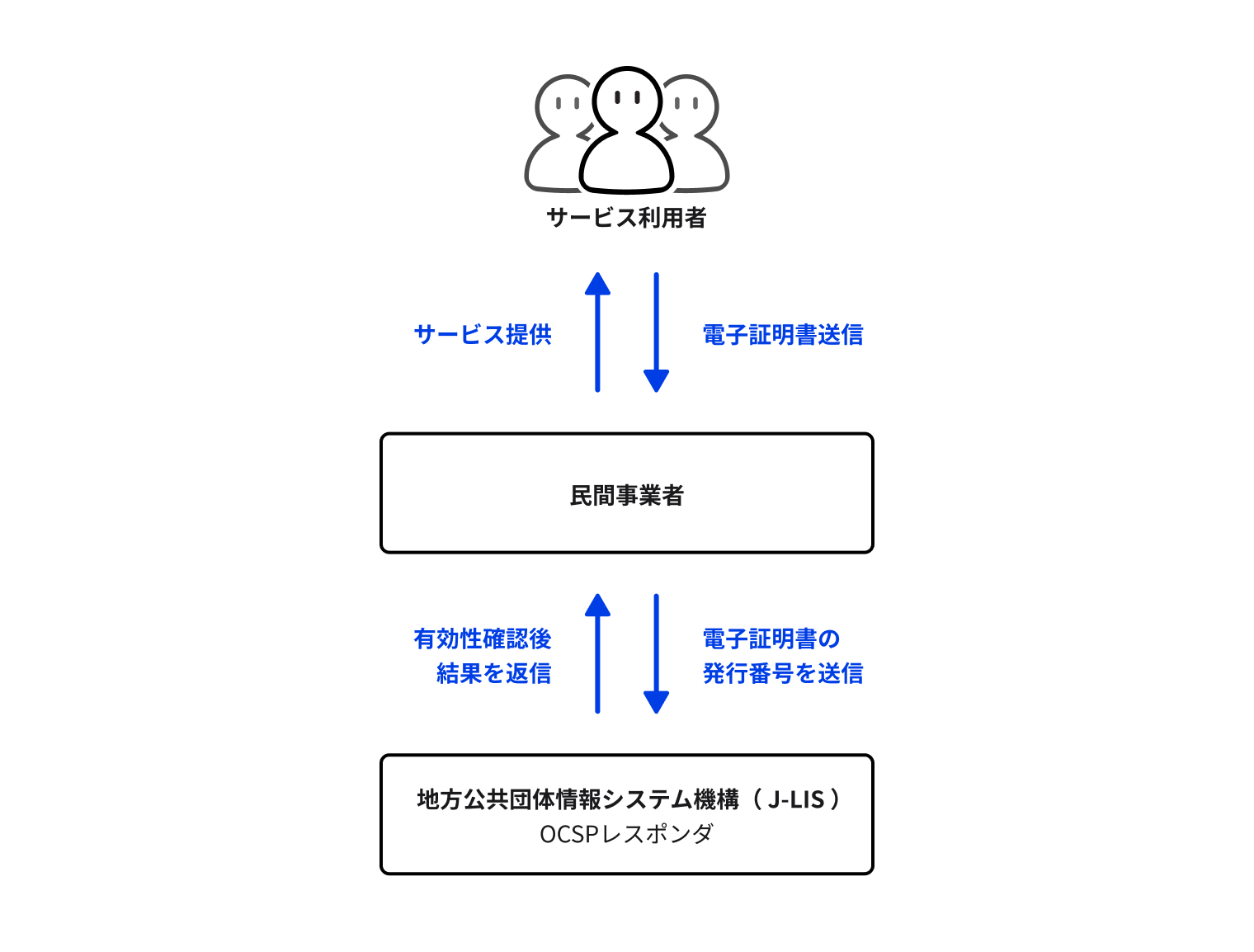
Figure 3 OCSP Responder Method
5.2. Type of electronic certificate
There are two types of electronic certificate: a "signature electronic certificate" and a "user certification electronic certificate".
5.2.1. Signature electronic certificate
It is used when creating and sending electronic documents such as applications and contracts on the Internet, etc. It is possible to confirm that the electronic documents created and sent by the users are "authentic documents created by the users and sent by the users." Electronic signatures using signature electronic certificate can be subject to Article 3 (Presumption of Authentic Establishment of Electronic Records) * 7 of Act on Electronic Signatures and Certification Business. In other words, an electronic document for which an electronic signature satisfying certain requirements is made by the Principal is presumed to be authentic (created based on the Principal's intention).
* 7 Quoted from Act on Electronic Signatures and Certification Business Rule 3.
An electromagnetic record that is prepared in order to express information (excluding those prepared by public officer in the course of his / her duties) shall be presumed to be established authentically if electronic signatures (limited to those that can be performed by the principal alone by appropriately managing codes and objects necessary to perform this) have been performed by the principal with respect to the information recorded in said electromagnetic record.
5.2.2 electronic certificate for User Identification
It is mainly used to log in to Internet sites, etc., and it is possible to confirm that the person who has logged in is the actual user.
Since the purpose of use differs between the electronic certificate for signature and the electronic certificate for user certification, there are differences in the information to be maintained. The main difference is whether or not the basic four information (address, name, gender, date of birth) is maintained within electronic certificate. For the electronic certificate for signature, which is used for the purpose of electronic signatures at the time of application, etc., the basic four information is maintained within the electronic certificate because it is necessary to confirm the correct address, etc. of the applicant, etc. The electronic certificate for user certification, which is used for login to Internet sites, etc., is sufficient as long as the person's identity can be confirmed, and therefore, the basic four information is not maintained.
For details of "5.2 Types of electronic certificate", please refer to the following.
6. Japanese Public Key Infrastructure function Expansion
6.1. Service for providing the latest user information (four types of information) (launched on May 16, 2023)
Overview of the Services
This is a service that enables customers to make on-line inquiries to J-LIS (Japanese Public Key Infrastructure) at any time regarding the latest four pieces of information (address, name, date of birth, and gender) on the assumption that the customer's prior consent has been obtained using Japan Agency for Local Authority Information Systems. This enables financial institutions, for example, to immediately confirm changes in the customer's address, etc.
This service was launched on May 16, 2023. An overview is provided below.
Details of this service can be found in "5. Overview of the Service to Provide Updated User Information (basic four information) based on the consent of the individual (pages 43 to 49)" below.
The provision of the Service by private sector is subject to the consent of the Customer.
The consent should be easy for customers to understand and must be obtained without fail. For obtaining consent, please refer to the notes provided in the following documents.
- Latest User Information Based on the Public Personal Authentication Act (basic four information) Obtaining Consent for Services Provided (PDF / 363 kb) (updated on April 13, 2026)
Procedures for using this service
This service is an additional service of Japanese Public Key Infrastructure. So, at first, you need to follow a procedure to use private sector at Japanese Public Key Infrastructure.
After completing the Japanese Public Key Infrastructure procedures, please go through the procedure for using this service.
For Japanese Public Key Infrastructure details, please refer to "electronic certificate (for private sector) (Ministry of Internal Affairs and Communications) Electronic certificate on the Japanese Public Key Infrastructure (to private sector) (Ministry of Internal Affairs and Communications) Japanese Public Key Infrastructure.
The necessary procedures for using this service are as follows.
- Service provider businesses (businesses that use Japanese Public Key Infrastructure by entrusting signature verification services to platform businesses)
A service provider is able to receive the information necessary to support the system from the platform operator to whom the signature verification work is entrusted.
Platform operators supporting this service are as follows.
- List of platform operators that support the service to provide the latest user information (4 information) (PDF / 699 kb) (as of June 10, 2026)
- Platform business operators (business operators using a Japanese Public Key Infrastructure that has itself been certified by the competent minister)
It is necessary to apply to J-LIS to use this service. Please contact the following contact information.
Contact:
On top of that, it is necessary to apply for the disclosure of technical specifications, etc., after making a pledge on confidentiality obligations with J-LIS.
6.1.1. The "Support Service for Obtaining Personal Consent," which utilizes Mynaportal and is required for the "basic four information Provision Service," was launched on October 29, 2024.
By using this service, private sector can obtain the consent of customers necessary for using the "Service to provide the latest users information (4 information)".
For new customers, it is easy to obtain consent from customers when applying. However, as a way to smoothly obtain the consent of the person himself / herself also for existing customers, we launched the "Consent Acquisition Support Service." For details, please refer to the following.
Advantages of using this service
- Advantages for business operators
- It will be easier to obtain the consent of existing customers.
- The system development cost for consent acquisition is reduced.
- After obtaining approval, the administrative cost related to the procedure for changing the basic four information such as address will be reduced.
- Erroneous input or the like of a change document of a customer can be prevented, and the customer information can be always updated.
- Benefit to the people
- By using the Mynaportal, the procedure is easy.
- When there is a change in address, etc. due to moving, etc., the necessary procedures are unnecessary.
Examples of guidance e-mails to customers
Please refer to the following for information on the consent procedure. The text data of the email sample will be distributed when the specifications are disclosed.
Contact Information
For inquiries about this service, please contact the following.
Forms: regarding the use of
*Please select "basic four information Services Provided" for the question "5. Please select the content of your inquiry."
6.2. Installation in smartphones of My Number Card's function (electronic certificate) (launched on May 11, 2023)
By installing the function of electronic certificate in My Number Card on a smartphone, it has become possible to apply for and use various My Number Card services anytime and anywhere with just one smartphone, without carrying around the My Number Card.
Details are provided below. Please refer to them when considering the use of this service. We will continue to expand the information gradually.
- Electronic certificate service for smartphones
- Study Group on Smartphone Installation in function in My Number Card
7. Inquiry
7.1. Frequently Asked Questions (FAQ)
Please refer to the following page for frequently asked questions (FAQ).
7.2. Inquiries
7.2.1. My Number Card in General
For inquiries about My Number Card in general, please refer to Inquiries about My Number System .
7.2. 2. Introduction of Japanese Public Key Infrastructure
Regarding the introduction of Japanese Public Key Infrastructure, please inquire from the inquiry form regarding the use of [Digital Agency] My Number Card (Japanese Public Key Infrastructure).
We also accept inquiries from those who would like to hold a briefing session for groups and those who would like to consult with us. At the briefing session, we hold briefing sessions for groups so that Japanese Public Key Infrastructure can be used by as many private sector as possible, and introduce information that is useful for considering the introduction of My Number Card, such as an overview of Japanese Public Key Infrastructure and Japanese Public Key Infrastructure, examples of use, the latest trends, and an overview of Mynaportal.
7.2.3. About the competent minister authorization in Japanese Public Key Infrastructure
Please e-mail us at the following address:
When you send an e-mail, please enter the information in the e-mail to the two e-mail addresses in Digital Agency and Ministry of Internal Affairs and Communications.
- Send To
To prevent spam mail, "_ atmark _" is displayed instead of "@". When sending mail, please replace "_ atmark _" with "@" (one byte).- Email address (Digital Agency): jpki-daijinnintei _ atmark _ digital. go. jp
- Email address (Ministry of Internal Affairs and Communications): kouteki-kojin _ atmark _ soumu. go. jp
- What to Send
- Email Subject
- Enter "Inquiries about platform operator Systems, etc. (name of business / organization)"
- Mail Body
- Name of company / organization, name of department, name of person in charge, contact information (e-mail address & phone number)
- Email Subject
7.2.4. Other Services
For other services, please check each service site.
- Use of digital authentication services
- Use of Mynaportal APIs
- Use of the app for reading the IC chip in My Number Card
7.2.5. Contact information on services provided by platform operators
If you would like to know more information about the services that platform operator provides for its customers or SP operators, please contact platform operator below.
When sending e-mail, please replace " _ atmark _ " with "@" (one byte). " _ atmark _ " is used instead of "@" to prevent spam mail.
- Organization to Promote a Common Platform for ICT Town Development
- Department in charge: Engineering Department
- Contact: ogura _ atmark _ topic. or. jp
- Service introduction material: Guide to myTAP (PDF / 1,936 kb)
- NTT DATA CORPORATION
- Department in charge: Digital Community Division, Social Infrastructure Solutions Business Headquarters
- Contact: bizpico-service _ atmark _ kits. nttdata. co. jp
- Service introduction material: Guide to BizPICO (PDF / 1,498 kb)
- GMO Global Sign, Inc.
- Department in charge: GMO Online identity verification Service Inquiry Desk
- Contact: Contact Form (GlobalSing by GMO)
- Service introduction material: Guide to identity verification (PDF / 770 kb)
- NEC Corporation
- Department in charge: New Business Creation Group, Social and Public Integration Department
- Contact: ss _ atmark _ mcas. jp. nec. com
- Service introduction material: Guide to My Number Card Certification Service (PDF / 1,795 kb)
- CYBERLINKS CO.,LTD.
- Department in charge: Planning Sales Section, Public Sales Department, Public Cloud Business Department
- Contact: kikaku-eigyou _ atmark _ cyber-l. co. jp
- Service introduction material: Guide to Maina Sign (PDF / 1,034 kb)
- Cybertrust Co.
- Department in charge: Trust Service Management Department
- Contact: ctj _ reception _ atmark _ cybertrust. co. jp
- Service introduction material: Guide to iTrust identity verification Service (PDF / 2,594 kb)
- Toppan Co., Ltd.
- Department in charge: Hybrid BPO General Division
- Contact: Toppan website
- Nomura Research Institute, Ltd.
- Department in charge: Social DX Business Department
- Contact: nri-shomn-jigyo _ atmark _ nri. co. jp
- Workthy Co., Ltd.
- Department in charge: Financial Business Team
- Contact: t. eguchi _ atmark _ workthy. jp
- Service introduction material: Guide to Benefit-Your-Locality Hometown Tax "one-stop Special Exemption Application" made online (PDF / 714 kb)
- TISI Co., Ltd.
- Department in charge: My Number Card identity verification Service, Financial Business Promotion and Sales Management Department, Financial Business Planning and Sales Department, Financial Business Division 1
- Contact: info-fs _ atmark _ ml. tisi. jp
- Service introduction material: Guide to TISI Co., Ltd. "My Number Card identity verification Service" (PDF / 2,262 kb)
- Double Standard Inc.
- Department in charge: Data Management Group / Data Management Department
- Contact: Inquiries (double standard)
- Service introduction material: Guide to Public Personal Authentication (PDF / 788 kb)
- Flight Solutions Co.
- Department in charge: Product & Financial Services Division
- Contact: myverifist _ atmark _ flight. co. jp
- Service introduction material: Guide to myVerifist & Cashless Service (PDF / 1,082 kb)
- Pocket Sign Co.
- Contact: Pocket Sign Website
- Service introduction material: Guide to POCKETSIGN Platform (PDF / 1,229 kb) (updated on June 1, 2026)
- Bengo4.com,Inc.
- Department in charge: CloudSign Business Division
- Contact: contact _ atmark _ cloudsign. jp
- Service introduction material: Guide to CloudSign (PDF / 766 kb)
- Mirabo Co.
- Department in charge: Sales Department
- Contact: info _ atmark _ mi-labo. co. jp
- Service introduction material: Guide to mila-e certification (PDF / 1,451 kb)
- NTT DoCoMo Business Corporation
- Department in charge: Social Innovation Department, Business Solution Division
- Contact: auth-and-sign-lita _ atmark _ ntt. com
- Service introduction material: Guide to SmartLiTA (PDF / 1,919 kb)
- ACSiON Inc.
- Department in charge: Sales Department
- Contact: marketing _ atmark _ acsion. co. jp
- Service introduction material: Guide to ACSiON Japanese Public Key Infrastructure (PDF / 1,630 kb)
- Maso Inc.
- Department in charge: System Development Department, IT Division
- Contact: CONTACT (MRSO)
- Cloud Ship Co.
- Contact: tsuyoshi. hanai _ atmark _ growship. com
- Service introduction material: Guide to CrowdShipTrust (PDF / 2,710 kb)
- Co., Ltd.
- Contact: Co., Ltd.
- Service introduction material: Guide to TRUSTDOCK Japanese Public Key Infrastructure (PDF / 583 kb)
- Myna Wallet Co.
- Department in charge: Development Department
- Contact: info _ atmark _ mynawallet. co. jp
- Service introduction material: Guide to Maina Wallet (PDF / 862 kb)
- JMDC Co., Ltd.
- Department in charge: Insurance Division
- Contact: recoell-support _ atmark _ jmdc. co. jp
- Service introduction material: Guide to (PDF / 417 kb)
- PrimaGest Co., Ltd.
- Department in charge: New Business Promotion Department
- Contact: Primast Trust Services website
- Service introduction material: Guide to Pridest Trust Services (PDF / 3,331 kb) (updated on May 12, 2026)
- Liquid Co., Ltd.
- Department in charge: eKYC, customer success Department
- Contact: info _ atmark _ liquidinc. asia
- Service introduction material: Guide to LIQUID eKYC (PDF / 2,152 kb) (updated on April 13, 2026)
- AIFUL CORPORATION
- Department in charge: Digital Promotion Department 1
- Contact: asein _ operation _ atmark _ aiful. co. jp
The above list only includes businesses in platform operator that have agreed to be included in the list.
In addition, some platform operator operators do not provide electronic certificate validation function as a platform for SP operators.
8. Related Documents
8.1. Guidelines for private sector for Japanese Public Key Infrastructure Use
This is a guideline published by private sector for the purpose of supporting the consideration of the use of Japanese Public Key Infrastructure in Ministry of Internal Affairs and Communications and explaining the introduction procedure. It summarizes the outline and benefits of the service, guidance for using the service (information system facilities required by private sector, certification standards and procedures from the competent minister, electronic certificate verification fees), etc.
Please refer to this document if you want detailed and comprehensive information when considering the introduction of a service.
This report is available on the following Ministry of Internal Affairs and Communications website.
8.2. Flow of revocation information provision procedure for signature verifiers, etc. (private sector)
J-LIS introduces procedures, work flow and documents required for signature verification when private sector introduces Japanese Public Key Infrastructure as a platform operator.
Please refer to the following documents when confirming the necessary procedures with J-LIS.
For more information, please refer to the following J-LIS website.